Construction Procurement Methods: Choosing the Best Fit for Your Projects
Procurement is at the heart of every construction project. Get it wrong, and you’re looking at delays, budget overruns, and frustrated teams. But with the right approach, you can lock in savings, streamline workflows, and keep your projects on track.
So, how do contractors choose the best procurement method for their projects? It comes down to understanding the options, matching them to your needs, and knowing when to combine approaches for maximum impact.
The Two Pillars: Rate Contracts vs. RFQs
Most construction procurement boils down to two primary methods: rate contracts and requests for quotation (RFQs). Each has its strengths and specific use cases.
Rate Contracts
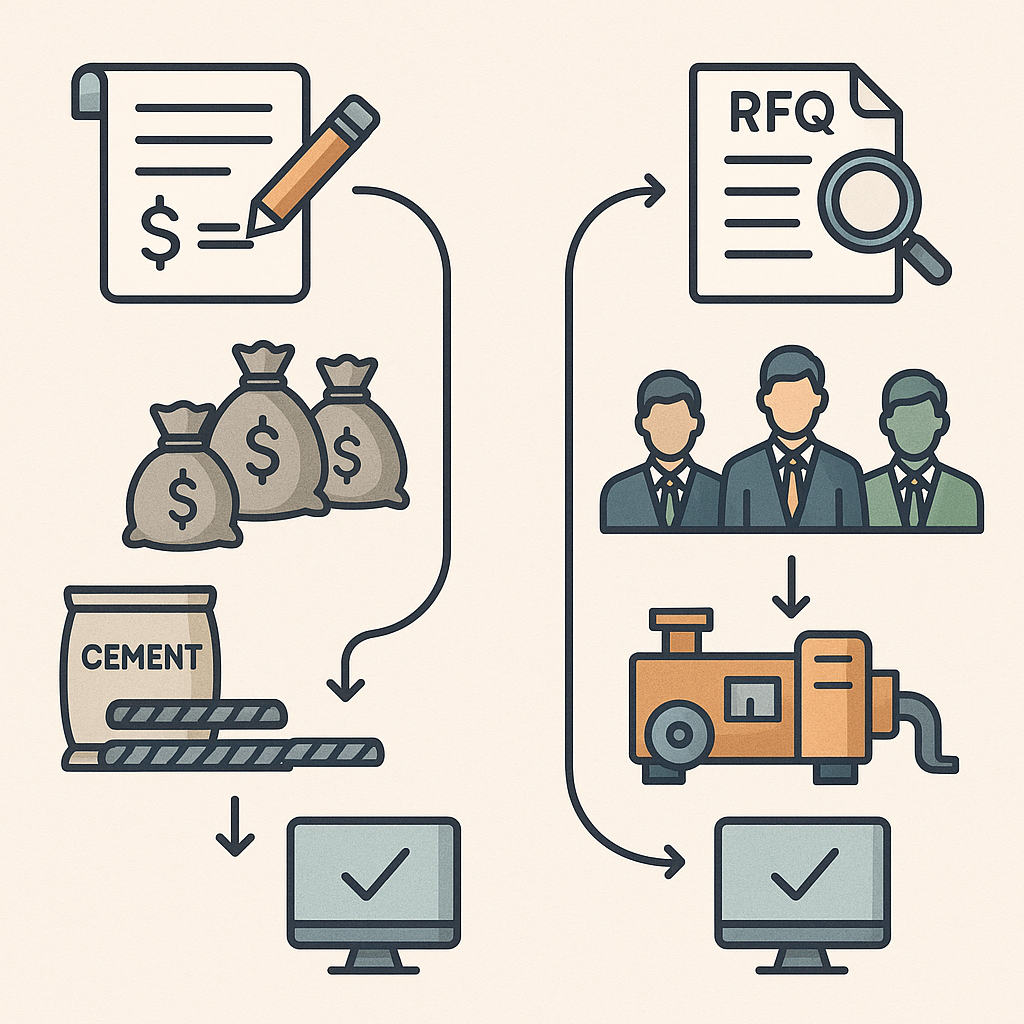
Rate contracts are pre-negotiated agreements with vendors for standard materials, often fixed for a specific period. They’re ideal for high-volume and frequently used items like cement, steel, aggregate, and plumbing fittings. The idea is simple: lock in bulk discounts and stable pricing before the project even starts.
Features of Rate Contracts:
- Pre-negotiated pricing: Contractors agree on fixed rates for materials over a defined time period, shielding them from price fluctuations.
- Bulk discounts: By committing to high-volume purchases, vendors provide better pricing.
- Streamlined ordering: Once the contract is in place, subsequent orders are faster since the terms are already decided.
- Predictability: Fixed rates help contractors maintain budget accuracy.
When to Use Rate Contracts:
| Criteria | Use Rate Contract |
|---|---|
| Purchase frequency | Materials ordered regularly across multiple projects |
| Price stability | Prices are relatively stable or fixable for the contract period |
| Volume | High-demand items where bulk discounts are achievable |
| Vendor relationship | Established, trusted vendors with a good track record |
| Procurement speed | Fast turnaround needed for repeated orders |
| Material type | Standard materials like sand, pipes, and consumables |
Steps to Set Up a Rate Contract:
- Identify High-Volume Materials: Analyze past projects to identify frequently used materials.
- Select Vendors: Shortlist trusted vendors with consistent performance and delivery records.
- Negotiate Terms: Discuss pricing, payment terms, and delivery schedules with vendors. Include clauses for price reviews if market conditions change drastically.
- Formalize Contracts: Ensure the terms are clearly documented, including penalties for non-compliance and dispute resolution mechanisms.
- Monitor and Renew: Track contract expiry dates and renegotiate terms before they lapse.
RFQs
Requests for quotation (RFQs) are best for one-off or infrequent purchases. Think custom-fabricated items, specialized equipment, or materials requiring detailed technical evaluation. With RFQs, you invite multiple vendors to bid, compare their offers, and select the best one based on cost, quality, and delivery timelines.
Features of RFQs:
- Competitive bidding: Encourages vendors to offer their best pricing and terms.
- Custom specifications: Tailored for materials or equipment that require precise technical details.
- Flexibility: Suitable for unique or low-volume requirements.
- Transparency: Clear evaluation criteria ensure fairness in vendor selection.
When to Use RFQs:
| Criteria | Use Standard RFQ |
|---|---|
| Purchase frequency | One-time or infrequent purchases for specific projects |
| Price stability | Prices fluctuate significantly (e.g., commodities) |
| Volume | Low-volume or specialty items |
| Vendor relationship | New vendors or situations needing competitive bidding |
| Procurement speed | Timeline allows for the full quotation cycle |
| Material type | Custom or technical materials needing detailed evaluation |
Steps to Effectively Use RFQs:
- Define Requirements: Clearly outline specifications, quantities, and delivery timelines.
- Shortlist Vendors: Focus on vendors with relevant experience and capacity to deliver.
- Share RFQs: Provide vendors with a structured format for submitting their bids.
- Evaluate Proposals: Compare bids based on cost, quality, lead time, and payment terms. Use tools to generate comparative statements.
- Award Contracts: Select the vendor offering the best value, not just the lowest price. Consider long-term relationships and reliability.
Combining Both Approaches: A Hybrid Model
Most contractors don’t rely solely on one method. In fact, using a hybrid approach is often the smartest move.
For example, contractors can finalize rate contracts for their top 20–30 high-volume materials before mobilizing the project. This locks in pricing during the budgeting phase, ensuring that estimates match actual procurement costs. For everything else—specialty items, equipment, or materials with volatile pricing—RFQs can fill the gap.
Benefits of a Hybrid Model:
- Cost Efficiency: Bulk discounts from rate contracts combined with competitive pricing from RFQs.
- Flexibility: Addresses both standard and unique procurement needs.
- Risk Management: Reduces exposure to price volatility for critical materials.
Best Practices for Hybrid Procurement:
- Negotiate Rate Contracts Early: Finalize them during the planning phase to avoid delays during execution.
- Monitor Expiry Dates: Keep track of active rate contracts to renew them before they lapse.
- Use RFQs for Specialty Items: Allow adequate response time for vendors to submit accurate bids.
- Leverage Material Requisition (MR) Collation: Combine material requisitions across projects for better bulk discounts.
- Evaluate Vendor Performance: Continuously review vendor performance for both rate contracts and RFQs to improve future procurement decisions.
Solving Common Procurement Challenges with JobNext
Here’s where tools like JobNext come in. JobNext’s procurement module simplifies both rate contract management and RFQ workflows.
How JobNext Helps:
- Rate Contracts: Track expiry dates, automate bulk pricing calculations, and ensure budget alignment.
- RFQs: Generate comparative statements ranking vendors (L1/L2/L3) by landed cost, delivery timelines, and payment terms.
- Smart Routing: Automatically direct material requisitions to stock or new purchases based on inventory levels.
- Budget Validation: Prevent unauthorized purchases by linking every requisition to the project’s budget.
Common Mistakes to Avoid
Mistake 1: Ignoring Stock Availability
Before raising a material requisition, check existing stock. You might already have what you need sitting in another job’s warehouse.
Mistake 2: Rushing RFQs
Vendors need time to submit competitive bids. Rushed timelines lead to inflated pricing or incomplete proposals.
Mistake 3: Overlooking Expiry Dates
Rate contracts don’t last forever. Proactive monitoring prevents sudden price hikes when contracts lapse.
Mistake 4: Using Generic Specifications
Be specific—grades, brands, dimensions. This reduces vendor queries and ensures correct delivery.
FAQ
1. What’s the difference between rate contracts and RFQs?
Rate contracts are fixed agreements for high-volume, standard materials, while RFQs are competitive bidding processes for specialty or infrequent purchases.
2. How do I avoid procurement delays?
Plan requisitions early—2–4 weeks for standard materials, longer for specialty items. Use tools like JobNext to track MR approvals and ensure timely RFQ action.
3. Can I use both methods on the same project?
Yes, hybrid approaches are common. Use rate contracts for bulk materials and RFQs for specialty items.
4. How does JobNext handle procurement approvals?
Every requisition is linked to the project’s budget, ensuring validation at each stage. Multi-level workflows prevent unauthorized spending.
5. How do I select the right vendors for rate contracts?
Evaluate vendors based on their track record, pricing, delivery timelines, and reliability. Prioritize those who have consistently met contractual obligations in the past.
Decision Framework: Rate Contracts vs. RFQs
| Factor | Rate Contracts | RFQs |
|---|---|---|
| Frequency of Purchase | High and repetitive | Low and project-specific |
| Material Type | Standardized items | Custom or technical items |
| Pricing | Fixed for contract duration | Variable, based on vendor bids |
| Speed of Procurement | Faster once the contract is in place | Slower, requiring a bidding cycle |
| Vendor Relationship | Established, long-term | Often involves new or multiple vendors |
| Budget Management | Predictable | Subject to market fluctuations |
Call to Action
If you’re dealing with procurement delays, budget overruns, or disconnected systems, JobNext can help. Get started free →
Learn more at JobNext.ai