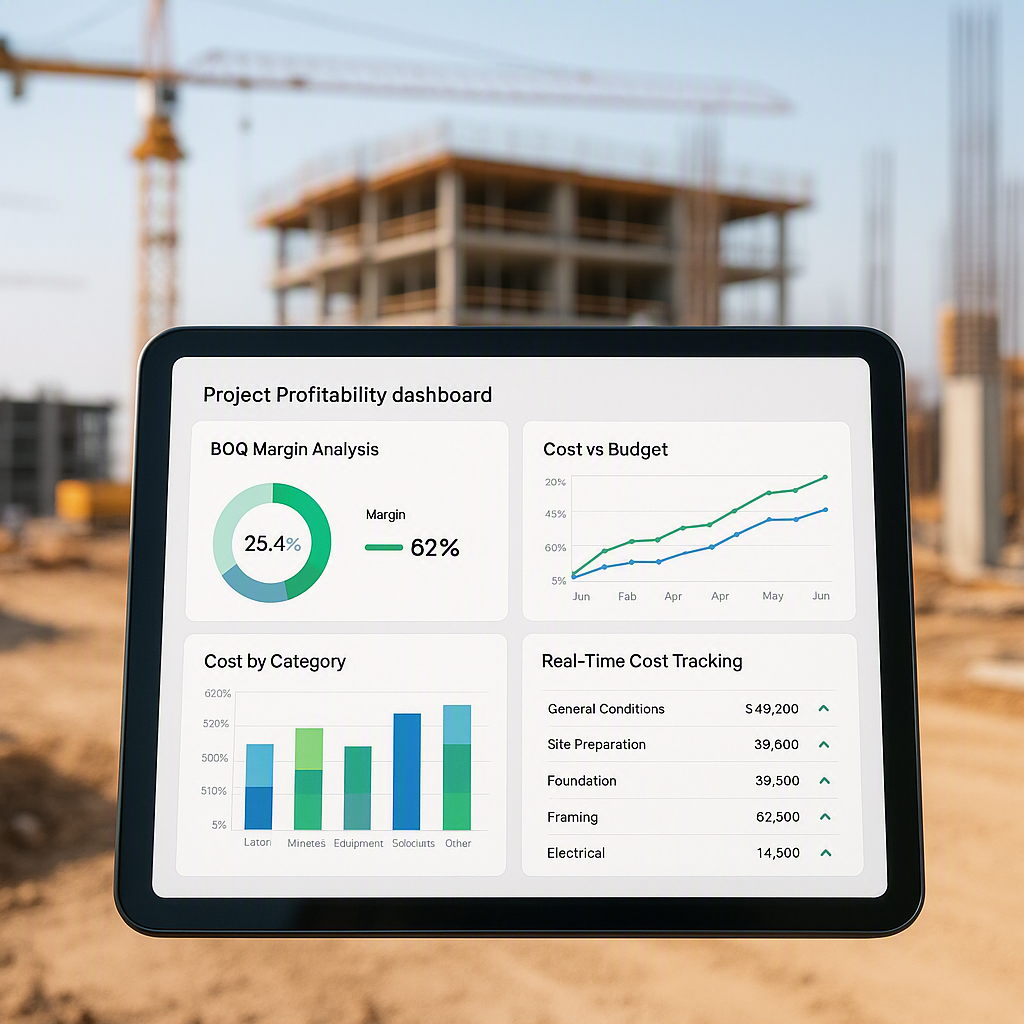
Residential Construction Margins: A Tightrope Walk
If you're in residential construction in India or the GCC, you already know: profit margins are thin. According to a 2023 McKinsey report on construction productivity, average margins across the sector hover between 5% and 10%. For residential projects, it's often worse. Why? Intense competition, fluctuating material prices, and delays caused by subcontractor inefficiencies all eat into profits.
But here's the kicker: many contractors lose money not because of external factors, but because they fail to track project costs accurately. This is where BOQ (Bill of Quantities) margin analysis could be a game-changer.
I used to think tracking high-level project budgets was enough to ensure profitability. "We just need to stay under the total cost cap," I told myself. Turns out, that mindset was a mistake.
The Wake-Up Call: A BOQ Line Item Gone Wrong
On one project, an unexpected variance in a specific package threw the entire budget off balance. A negative margin item in the BOQ had quietly been bleeding costs for weeks. By the time it was identified, the damage was done.
What went wrong? A vendor had increased prices mid-project, and no one flagged it. Worse, the supervisors onsite had approved additional quantities without reconciling them against the BOQ's original scope. A simple oversight, but costly.
This scenario isn't unique—many contractors face similar issues. The lack of detailed tracking at the BOQ level can make it impossible to spot where costs are spiraling out of control until it's too late.
Why Contractors Miss Margin Erosion
Looking back, it's clear why this happened:
1. Fragmented Systems
One of the main culprits is the lack of integration between teams. The procurement team, site supervisors, and finance department often operate in silos, relying on their own systems and methods to monitor project costs. This fragmentation prevents data from being shared promptly, leading to missed red flags. For example, if procurement approves a price increase for materials, the finance team may not be aware until the next reconciliation cycle.
Practical Example:
Imagine the procurement team negotiating a better price for steel rods but failing to update the BOQ system. The site supervisor might continue ordering at the old price, resulting in unnecessary overspending. If the finance team only reviews this month's expenses after 30 days, the discrepancy might go unnoticed.
Actionable Steps to Solve This Issue:
- Use an integrated project management system that connects procurement, finance, and site operations.
- Appoint a cost controller or project accountant whose role is to monitor real-time updates in the BOQ.
- Standardize workflows so that any cost changes require cross-departmental approval and are immediately reflected in the BOQ.
2. Irregular Monitoring
Periodic reviews, often done monthly or bi-weekly, are a common practice. However, project costs can escalate much faster than the review cycle can catch them. Weekly BOQ-level reviews are essential for staying on top of variances.
Actionable Steps to Improve Monitoring:
- Implement weekly BOQ reviews as a non-negotiable process.
- Use software tools that offer dashboards and real-time insights to streamline these reviews.
- Create a checklist for the review process to ensure that every BOQ item is examined systematically.
3. Lack of Tools
Spreadsheets are still widely used in residential construction, but they have limitations. They don’t provide real-time alerts or contextual insights when things deviate from the plan. Without tools specifically designed for proactive monitoring, oversights are inevitable.
Actionable Steps to Upgrade Tools:
- Evaluate construction project management software tailored to BOQ tracking, such as JobNext or similar platforms.
- If starting with spreadsheets, use advanced features like conditional formatting, pivot tables, and data validation to reduce errors.
- Train your team to adapt to the new tools and emphasize the long-term benefits of automation and real-time monitoring.
Enter BOQ Margin Analysis
This experience made me rethink our approach. Instead of focusing only on high-level budgets, we started using BOQ margin analysis to track profitability at a granular level. Here's how it works:
The BOQ Margin Report compares the contracted value of each BOQ item (e.g., cladding, concrete, plumbing) against actual costs incurred. These costs are broken down into five categories: Labour, Material, Plant, Subcontractor, and Overhead.
Illustrative Example —
| BOQ Item | Contracted Value | Actual Cost | Margin (%) |
|---|---|---|---|
| Cladding Package | ₹50,00,000 | ₹52,00,000 | -4% |
| Concrete Works | ₹1,20,00,000 | ₹1,18,00,000 | +1.7% |
| Plumbing | ₹30,00,000 | ₹29,50,000 | +1.6% |
What Makes BOQ Margin Reports Effective?
1. Real-Time Visibility
Unlike static budgets, BOQ margin reports update dynamically as costs are logged. This ensures that project managers and finance teams have access to the latest data at all times. For example, if material costs for plumbing suddenly spike due to vendor price changes, the BOQ margin report will reflect this immediately.
Actionable Steps:
- Choose software or systems that allow real-time updates for all BOQ items.
- Train staff to input data accurately and promptly, ensuring the integrity of the reports.
2. Actionable Insights
Negative-margin items stand out immediately, enabling teams to investigate and resolve issues before they snowball. For example, a margin drop in the "Cladding Package" might prompt an inquiry into whether material costs have increased or whether additional quantities were approved without authorization.
Actionable Steps:
- Use color-coded alerts to highlight negative-margin items in reports.
- Assign issue owners: designate team members responsible for investigating and resolving specific variances.
3. Root Cause Identification
By breaking costs into categories—Labour, Material, Plant, Subcontractor, and Overhead—you can pinpoint the source of the issue. For example, if material costs are rising, you can negotiate with vendors or explore alternative suppliers.
Actionable Steps:
- Disaggregate each BOQ item into its cost components and analyze variances separately.
- Regularly update cost benchmarks for labour, materials, and subcontractor rates for better accuracy.
Practical Steps for Contractors
To leverage BOQ margin monitoring effectively, residential contractors in India and GCC should consider the following steps:
1. Weekly Reviews Are Non-Negotiable
Set a weekly schedule for reviewing BOQ margin reports. As JobNext's help documentation emphasizes, catching negative-margin items early is critical. Waiting until month-end is too late.
Actionable Steps:
- Assign a specific time each week for BOQ review.
- Ensure all relevant team members (procurement, finance, and site supervisors) contribute to the review.
- Use collaborative tools to enable seamless sharing and discussion of margin reports.
2. Integrate Procurement and Finance
Ensure your procurement workflows—Material Requisition (MR), Request for Quotation (RFQ), and Purchase Orders (PO)—sync directly with your BOQ tracking system. Tools like JobNext automate this process, ensuring every approved expense is tied to a BOQ item.
Actionable Steps:
- Use software that integrates procurement and finance workflows.
- Train your team on linking all material or subcontractor expenses to BOQ items.
3. Drill Down When Needed
Use summary reports to get a high-level view but drill into detailed reports for items showing variances. For example, if "Concrete Works" shows a margin drop, check whether it's due to material price variance, excess quantities, or subcontractor billing errors.
4. Set Threshold Alerts
Configure your software to flag BOQ items whenever margins drop below a preset threshold. This way, you don't have to hunt for issues—they come to you.
Actionable Steps:
- Define acceptable margin thresholds for each BOQ item.
- Use automated alerts or notifications to identify breaches.
- Create a protocol for investigating flagged items.
Common Mistakes to Avoid
1. Ignoring Small Variances
A 1-2% variance might seem minor, but it can quickly add up across multiple BOQ items. Consistently monitoring even small deviations is critical for long-term profitability.
2. Relying Solely on Spreadsheets
Manual tracking in spreadsheets is error-prone, time-consuming, and lacks automation features. Invest in software that integrates procurement, finance, and project tracking.
3. Skipping Weekly Reviews
Consistency is key. Skipping even one review can let issues snowball into unmanageable problems.
Decision Framework: Implementing BOQ Margin Analysis
| Criteria | Basic Approach (Manual) | Software Solution (Automated) |
|---|---|---|
| Cost | Low (Excel is free) | Medium to High |
| Ease of Use | Requires training | Intuitive interfaces available |
| Real-Time Monitoring | No | Yes |
| Scalability | Limited by manual input | High |
| Error Reduction | Prone to human error | Automated alerts prevent errors |
| Initial Setup Time | Short | Moderate |
| Long-Term Efficiency | Low | High |
Final Thoughts
If you're a residential contractor struggling to maintain margins, BOQ margin reports could be your lifeline. They offer the visibility you need to catch issues early and stay profitable in an unpredictable market. The shift from high-level project budgets to granular BOQ-level monitoring might seem daunting at first, but the benefits in terms of profitability and reduced stress are undeniable.
Interested in tools that simplify BOQ margin tracking? JobNext can help. Start improving your project profitability today.
Learn more at JobNext.ai