Net Profit Margins Are Brutal in Construction
Let’s not sugarcoat it. If you’re a contractor, you’re probably operating on thin net profit margins—usually between 3% and 8%, according to industry benchmarks like Construction Dive. That’s assuming you’re not one of the unlucky ones who dip into negative territory because of cost overruns, mismanaged billing, or subcontractor issues.
Why is this such a tough industry for profits? Because nearly every project is a minefield of risks. Material costs fluctuate. Labour shortages drive up wages. Scope creep erodes margins. And the biggest culprit? Poor cost tracking. If you don’t know where your money is going until it’s too late, you’re not running a business—you’re gambling.
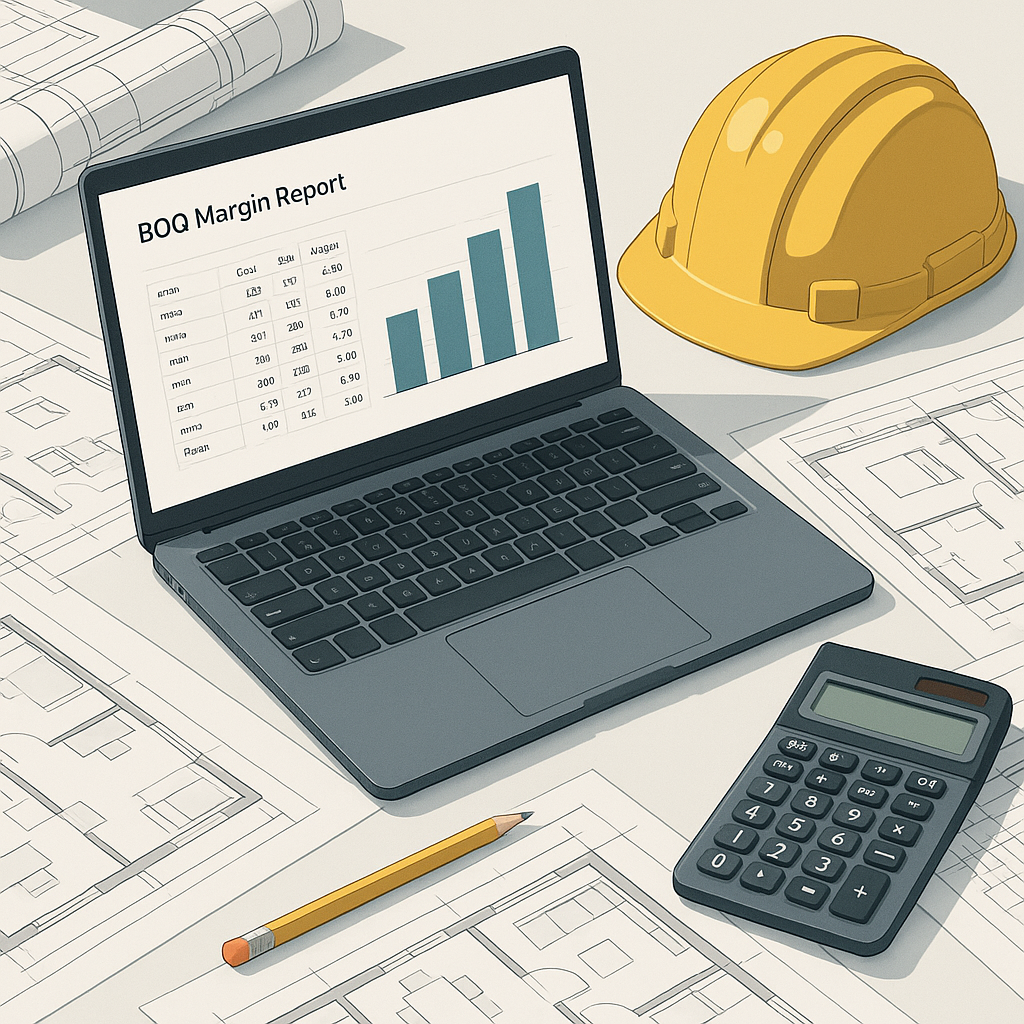
The good news is that construction profitability can be improved, but it requires precise tracking and proactive management. One of the most effective tools for this is a BOQ (Bill of Quantities) margin report. Done right, these reports aren’t just spreadsheets—they’re your early warning system.
What Is a BOQ Margin Report, and Why Does It Matter?
A BOQ margin report breaks down project profitability by analyzing costs (labour, materials, overhead, subcontractors, and plant) against the contracted BOQ values. In simple terms, it shows you whether each item in your BOQ is making or losing money.
Why’s this critical? Because most projects don’t blow their entire budget at once. They bleed out slowly—one underestimated line item at a time. A single BOQ item with negative margins can snowball into six-figure losses if ignored.
Consider this example: A contractor prices 10 tons of steel at ₹60,000 per ton, but actual procurement costs turn out to be ₹65,000 per ton. Without a BOQ margin report, this discrepancy might go unnoticed until the final accounting—when it’s too late to recover those losses. A BOQ margin report highlights such problems in real-time, allowing teams to act quickly.
JobNext’s BOQ Margin report, for instance, flags negative-margin items early—before they sink the job. It’s not magic; it’s just methodical tracking. Their documentation recommends reviewing this report weekly. If you’re not doing this already, you’re flying blind.
How BOQ Margin Reports Save Margins (and Your Sanity)
Here’s how contractors can use BOQ margin reports to stop margin erosion:
1. Catch Estimation Errors Early
One of the most common sources of margin erosion is errors during the estimation phase. For example, underestimating material costs or labour hours can lead to significant losses. A BOQ margin report lets you compare estimated costs with actual costs as the project progresses. This allows you to identify discrepancies early and make adjustments before they spiral out of control.
Actionable Steps:
- Compare estimated vs. actual costs for materials, labour, and subcontractors weekly.
- If discrepancies are found, investigate the cause (e.g., supplier price increases, inaccurate labour hour forecasts).
- Implement corrective actions such as renegotiating procurement terms, issuing change orders, or reallocating resources.
2. Spot Scope Creep Immediately
Scope creep happens when a project’s requirements expand beyond what was originally agreed upon. It’s often subtle—a few extra site visits, additional subcontractor tasks—but these changes can pile up on your budget. BOQ margin reports highlight deviations from initial estimates so you can quickly address scope creep.
Actionable Steps:
- Use BOQ margin reports to track cost overruns caused by unapproved changes.
- Communicate deviations to clients and issue variation orders promptly.
- Train your project managers to monitor task additions and document scope changes rigorously.
3. Improve Procurement Strategy
Procurement inefficiencies are another major contributor to margin erosion. Contractors often overpay for materials due to lack of competitive bidding or supplier relationships that haven’t been optimized. BOQ margin reports let you identify which materials or subcontractor packages consistently exceed budget.
Actionable Steps:
- Use past BOQ margin reports to identify items with recurring negative margins.
- Work with procurement teams to negotiate better terms with suppliers or switch to more competitive vendors.
- Consider centralized procurement systems to standardize purchasing across projects.
4. Align Teams Around Accountability
Construction projects involve multiple teams—estimating, procurement, site execution, and billing. BOQ margin reports create visibility for everyone. If the report shows that labour costs are exceeding the budget, you can ask site managers to justify the variance. Accountability improves when everyone knows their numbers are being tracked.
Actionable Steps:
- Share BOQ margin reports with all relevant teams (estimating, execution, procurement).
- Hold weekly margin review meetings to discuss variances and corrective actions.
- Establish key performance indicators (KPIs) for team accountability, such as maintaining labour costs within 5% of estimates.
A Framework for Using BOQ Margin Reports Effectively
If you’re new to BOQ margin tracking, here’s a step-by-step framework to implement it effectively:
| Step | Action | Frequency |
|---|---|---|
| Set Up Reports | Use tools like JobNext to auto-generate BOQ margin reports. | During planning |
| Review Regularly | Schedule weekly reviews of BOQ margin reports with project teams. | Weekly |
| Investigate | Drill down into negative-margin items to find the root cause. | Immediately |
| Take Action | Adjust procurement, renegotiate contracts, or issue change orders. | As needed |
| Refine Processes | Update estimation and procurement practices based on findings. | Post-project |
Following this framework ensures you’re not just reacting to problems—you’re preventing them.
Common Mistakes to Avoid
- Reviewing Too Late: Waiting until the end of a project to review margins is financial suicide. Weekly reviews are non-negotiable.
- Ignoring Small Losses: A ₹5,000 loss on one BOQ item might seem minor—until it happens 200 times.
- Blaming the Wrong Team: Negative margins aren’t always the site team’s fault. It could be an estimation error or an unvetted subcontractor.
- Skipping Post-Project Analysis: If you don’t learn from one project’s mistakes, you’re doomed to repeat them.
FAQ
1. What’s the difference between a BOQ margin report and a P&L statement?
A P&L statement shows overall company profitability. A BOQ margin report dives into project-level profitability, breaking it down by individual BOQ items.
2. How does this help with subcontractor management?
If a subcontractor’s work consistently shows negative margins, it’s a red flag. You can renegotiate or replace them before they cause more damage.
3. Can’t I just rely on my finance team?
No. Finance teams look at financials in aggregate. BOQ margin reports let project managers catch issues on a granular level—before they hit the P&L.
4. Do I need special software for this?
Yes, if you want real-time insights. JobNext automates BOQ margin tracking and integrates it with procurement, billing, and site workflows.
5. How do I handle client pushback on variation orders?
Use the BOQ margin report as evidence to show how scope changes have impacted costs. Transparency builds trust and makes it easier to negotiate.
Final Thoughts
Getting your margins above 8% isn’t impossible. But it requires discipline. BOQ margin reports are a simple yet powerful way to identify and fix profit leaks before they sink your projects. If you’re serious about improving profitability, start with structured tracking systems.
If you’re dealing with margin erosion, JobNext can help. Its BOQ margin reports give you the insights you need to protect your profits. Get started free →
Learn more at JobNext.ai